Understanding Cloud Computing Networks: Architecture, Applications, and Visual Tools
The term Cloud Computing Network refers to the underlying infrastructure and interconnected systems that enable cloud services to function. It is distinct from a traditional corporate network, as it is designed to deliver scalable, on-demand computing resources over the internet. Rather than relying on a single, localized set of servers, a cloud computing network is a distributed architecture often spanning multiple global data centers. This network is the backbone that allows for the provisioning of virtual machines, storage pools, databases, and entire platforms as services.
What Distinguishes a Cloud Computing Network
Its primary distinction lies in its abstraction and elasticity. In a conventional on-premises setup, the network hardware, servers, and software are physically owned and managed, with capacity limits defined by that hardware. A cloud computing network, however, presents these resources as a virtualized, unified pool. The physical location and configuration of servers become less relevant to the end-user, who interacts with a logical network defined by software. This enables characteristics like rapid scaling, where additional network bandwidth or virtual servers can be allocated almost instantly to meet traffic spikes, and high resilience, where workloads can be shifted across different physical nodes within the network if one fails.
Key Architectural Components
While implementations vary between providers, core components typically include: virtual networks that isolate and connect cloud resources, load balancers that distribute traffic efficiently, gateways for secure external access, and sophisticated software-defined networking (SDN) controllers that manage the entire flow. The network is not just about connectivity; it integrates deeply with compute and storage layers to create a cohesive service environment.
Evaluating Cloud Networks Against Alternative Approaches
When considering infrastructure options, it's helpful to compare the cloud computing network model with other prevalent approaches. The most direct alternative is the traditional on-premises data center. Here, you own and control every router, switch, and cable. This offers maximum direct control over security configuration and network performance, but it comes with significant capital expense, requires specialized in-house expertise, and scaling often means lengthy procurement and installation cycles.
A hybrid approach is another common alternative, blending on-premises infrastructure with cloud services. This can be an excellent fit for organizations migrating gradually or those with legacy systems that cannot move to the cloud. However, it introduces complexity in managing two different network paradigms, ensuring secure and efficient connectivity between them, and often requires more sophisticated monitoring tools.
The decision often hinges on priorities. If your needs demand predictable, consistent network performance and you have the capital and skills to manage physical hardware, an on-premises network might be suitable. If your workloads are variable, you need to innovate quickly without heavy upfront investment, or you lack deep networking staff, a cloud computing network provides a clear advantage in agility and cost structure.
Practical Applications and Use Cases
Cloud computing networks are not just for tech giants; they enable a wide range of realistic business applications. A mid-sized e-commerce company, for instance, can use a cloud network to host its website, automatically scaling the backend server pool during holiday sales events while using integrated cloud network security services to protect against DDoS attacks. A software development team can spin up isolated virtual networks for testing new application features, replicating production environments without any new physical hardware.
In research and data analysis, cloud networks facilitate big data processing. Researchers can provision a temporary, high-bandwidth network connecting massive storage objects to parallel computing clusters to run complex simulations, paying only for the hours the network and resources are active. This democratizes access to powerful computing that was previously inaccessible to smaller organizations.
Recognizing Limitations and Tradeoffs
While powerful, cloud computing networks involve tradeoffs. One key consideration is latency. Although providers have global regions, if your end-users are geographically concentrated far from those regions, you may experience higher latency compared to a locally-hosted server. Network performance is also shared; while providers offer high-grade service level agreements, your virtual network shares underlying physical infrastructure with other tenants, unlike a dedicated on-premises line.
Cost predictability can be another factor. The pay-as-you-go model is efficient for variable workloads, but steady, high-volume traffic can sometimes lead to costs that are harder to forecast than a fixed lease line. Furthermore, migrating extremely complex, custom network configurations from an on-premises environment to a cloud model can be a significant project, requiring careful redesign.
Visualizing Concepts with Icon Sets
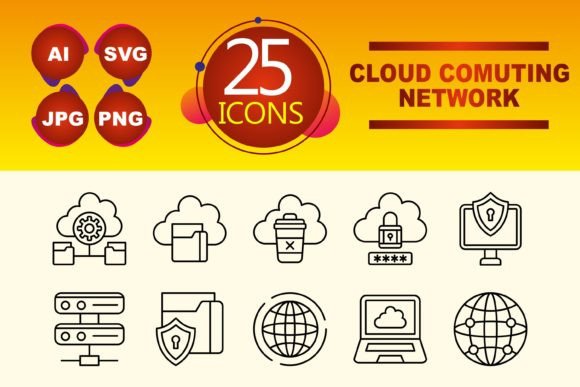
When communicating these often abstract network concepts in designs, documentation, or presentations, visual tools are invaluable. A set of Cloud Computing Network icons, such as a collection featuring line icon styles, can help diagram architectures, illustrate service offerings, or enhance user interfaces for management dashboards.
Consider a set that includes ten core symbols representing elements like virtual servers, network gateways, data storage clouds, load balancers, and secure connections. Using a consistent line icon style offers clarity and a modern, minimalist aesthetic suitable for technical materials. The availability of multiple file types—AI for editable vector design, JPG for simple raster use, PNG for transparent backgrounds in digital projects, and SVG for scalable web implementation—makes such a set practical for a wide range of applications.
These icons can be employed in mobile apps that monitor cloud health, website templates for IT service companies, presentation slides explaining migration plans, or infographics comparing cloud and traditional networks. They serve as a universal visual language, speeding up comprehension and creating professional-looking materials without requiring custom illustration from scratch.
Making an Informed Infrastructure Decision
Determining if a cloud computing network is the right choice depends on analyzing your specific context. It is often the strongest fit for businesses experiencing growth fluctuations, startups aiming to minimize initial infrastructure investment, projects requiring rapid deployment and experimentation, or organizations lacking extensive network operations teams. The managed, scalable nature reduces operational overhead.
Conversely, you might need another option if you operate in an industry with stringent data residency laws requiring data to stay in specific physical locations, if you run applications with ultra-low latency requirements that cannot be met by current cloud regions, or if you have already invested heavily in a sophisticated, optimized on-premises network that fully meets your static needs.
The evaluation should balance control, cost, agility, and compliance. By understanding both the architectural principles of a cloud computing network and the practical tools available to communicate its components, professionals can make more grounded decisions about adopting, integrating, or even visually representing this critical modern infrastructure model.