Beyond the Download: Using Valentine's Day Illustration -AI SVG EPS Effectively
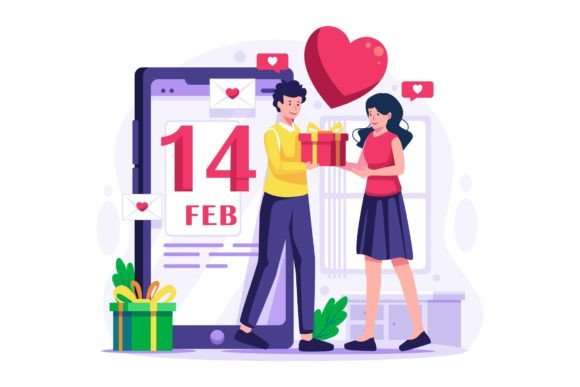
You've just found a beautiful Valentine's Day illustration – a young man giving a gift to his girlfriend, a couple in love, perfect for celebrating Valentine's Day or a birthday concept. The description promises versatility for desktop web, mobile web, landing pages, hero images, infographics, banners, and much more. The files are enticing: AI, EPS 10, SVG, PDF, PNG 300 DPI, JPG 300 DPI. It's 100% vector, compatible with Adobe Illustrator, easy to edit, and features a flat design style. It seems like a perfect solution for your project, whether you're a marketer crafting a campaign, a blogger designing a post, or a small business owner updating your website. But downloading this Valentine's Day Illustration -AI SVG EPS is just the first step. The real value – and potential pitfalls – lie in how you use it.
The Common Rush from Download to Application
A frequent mistake is treating premium vector illustrations as simple stock photos. The mindset is often, "I downloaded it, now I'll just place it." This overlooks the core advantage of a file bundle like this Valentine's Day Illustration -AI SVG EPS: its editability. Users might immediately grab the PNG or JPG for quick use, ignoring the AI, EPS, and SVG files. While this gets the job done fast, it locks you into a static image. Later, if you need to change the color scheme to match a brand update, remove an element, or resize it for a different format without quality loss, you'll be stuck. You've effectively used a Ferrari to drive to the end of your driveway.
Understanding Your File Formats
Each file in this bundle serves a distinct purpose, and choosing the wrong one can affect your project's quality and your own efficiency.
- AI/EPS/SVG: These are your vector files. They are not pixel-based images. They are mathematical equations defining shapes, lines, and colors. This means you can scale them to any size – from a tiny mobile icon to a massive billboard – with zero loss in clarity. They are fully editable in programs like Adobe Illustrator. You can change the gift box color, adjust the couple's clothing, or separate elements to use individually.
- PDF: Often a versatile container that can preserve vector data. Useful for sharing a viewable, non-editable version with clients or team members.
- PNG 300 DPI / JPG 300 DPI: These are raster files. They are fixed-resolution pixel images. The "300 DPI" indicates high print quality. Use these when you need a final, unedited asset for a specific, known size (like a social media post at 1200x1200 pixels) or for environments where vector files cannot be used (like some website CMS editors).
The mistake is using a raster file (PNG/JPG) for a project that requires future scaling or editing. The better approach: always open and save your master file from the AI or SVG vector source. Create your final PNG or JPG exports from this master file at the exact dimensions needed for each specific application.
Assuming "Easy to Edit" Means No Skill Required
The description says "Easy to edit customize," which is true for the file structure itself – layers are likely well-organized. However, many beginners and even professionals with limited vector software experience misinterpret this. They assume they can make complex edits without knowing how to use Illustrator's tools. A common result: frustration when trying to perform a simple task like recoloring the background, leading to abandoned customization and a generic-looking final design.
Practical advice: Before diving into editing, familiarize yourself with basic vector software functions. Learn how to select groups, use the color swatch tool, and work with layers. If you're on a tight deadline and lack these skills, consider a simpler workflow. Use the vector file to scale the artwork perfectly to your required size, then export it as a high-quality PNG. Use simpler, raster-based tools (even like Canva) to add overlays, text, or basic filters if needed. This preserves the illustration's quality while accommodating your current skill level.
Overlooking the "Flat Design Style" Context
The illustration is described as having a "Flat Design Style." This is a specific aesthetic choice – minimal, two-dimensional, often with bold colors and clean geometry. A misunderstanding occurs when users try to force this flat illustration into a project with a drastically different visual theme, like a photorealistic or heavily textured website. The clash can make the illustration feel cheap or out of place, harming the overall design cohesion.
Before applying the Valentine's Day Illustration -AI SVG EPS, assess your project's overall visual language. Does the flat style complement it? If not, the vector format gives you a starting point for adaptation. You could use the illustration's outlines and composition but add subtle gradients, shadows, or textures within your editing software to bridge the stylistic gap. The key is to see the download not as a final asset, but as a highly adaptable template.
Ignoring License and Usage Scope
While this particular description doesn't mention licensing, it's a critical, often-overlooked detail for any digital asset. The text says "You can use this design for your projects..." but professionals must ask: for what type of projects? Personal? Commercial? Client work? Is there a limit on print runs or website views? Mistakenly using an illustration with a restrictive license for a large-scale commercial campaign can lead to legal issues and financial penalties.
Always check before you use. If the download source doesn't provide clear license terms, seek clarification or assume a conservative, personal-use-only stance. For critical commercial projects, invest in assets from reputable marketplaces with explicit, commercial-friendly licenses. This protects your work and your reputation.
Failing to Plan for Multi-Format Use
The illustration is promoted for use across desktop web, mobile web, landing pages, hero images, infographics, and banners. A common error is designing it for one format only. For example, you might create a stunning hero image version for desktop but forget that on mobile, the intricate details of the couple and gift might become too small and lose impact.
A better approach leverages the vector files from the Valentine's Day Illustration -AI SVG EPS bundle to plan a multi-format strategy from the start. Edit your master file to create variations. For a hero image, you might use the full scene. For a mobile banner, you could isolate just the couple's faces and the gift, enlarging them for clarity. For an infographic icon, you might use just the gift box element. By thinking in terms of adaptable components, you maximize the value of your single download across your entire project ecosystem.
The Final Check Before You Begin
Before you open that AI file or drop that PNG into your design, take a moment for a constructive review. First, confirm you have the software to edit the vector files (like Adobe Illustrator or a compatible alternative). Second, understand the specific needs of your project: final sizes, color palette, and stylistic context. Third, have a clear plan for which file format is your editable master and which are your final exports. Finally, always verify the usage rights to ensure your application is permitted.
By approaching this Valentine's Day Illustration -AI SVG EPS with this mindful, informed strategy, you move from simply using a stock image to actively crafting a customized visual asset. You avoid the frustrations of limited files, stylistic mismatches, and legal uncertainties. Instead, you unlock the true potential of a versatile vector download, creating tailored, high-quality designs that effectively communicate your message of love, celebration, or connection, precisely how you intended.